
A full automatic duct production line changes how you make ductwork. It brings feeding, cutting, forming, and folding together in one smooth CNC-controlled process. You get faster output, steady quality, and lower labor costs. These benefits of a full automatic duct line matter for every HVAC shop.
LOCKFORMING builds full automatic duct line systems that deliver these results. You make more duct pieces in less time. Your team focuses on assembly instead of manual forming. This article explains the specific features and mechanisms behind these gains.
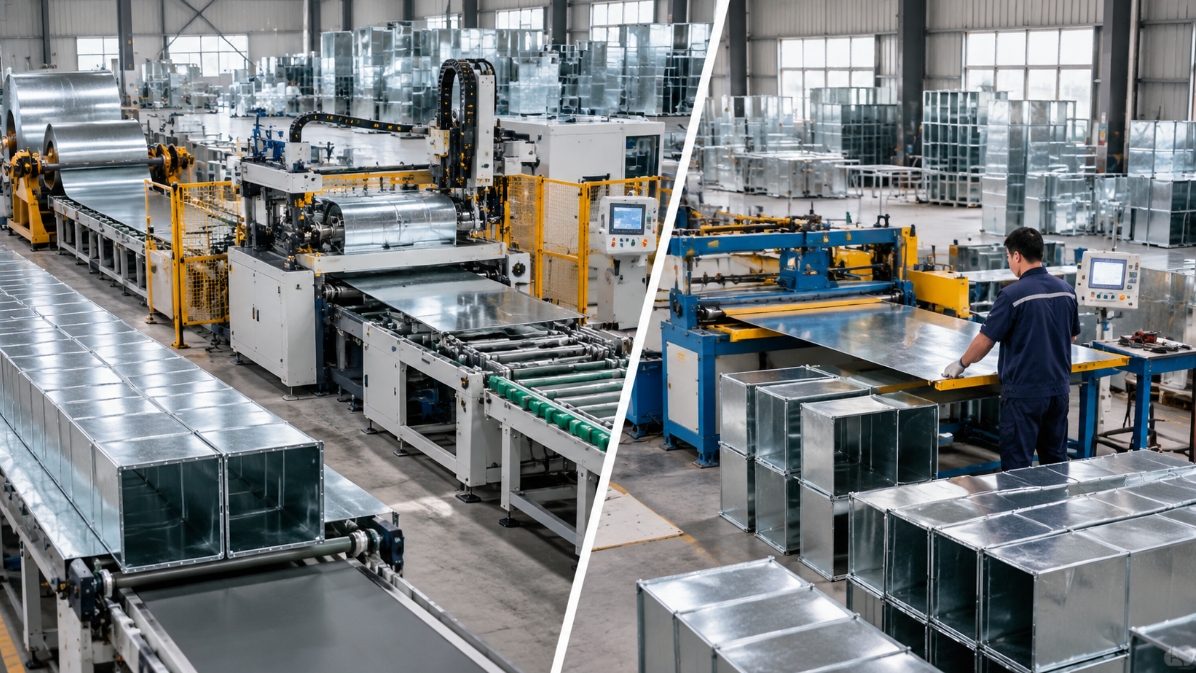
The LOCKFORMING Duct Manufacturing Auto Line VI shows what a full automatic duct production line can do. This system uses a U-shaped layout. That design saves floor space and cuts the time your team spends moving raw material. You get a smooth flow from one end to the other.
Boost Efficiency with Auto Line VI
Discover the LOCKFORMING Duct Manufacturing Auto Line VI for unmatched automation, precision, and speed in HVAC duct production.
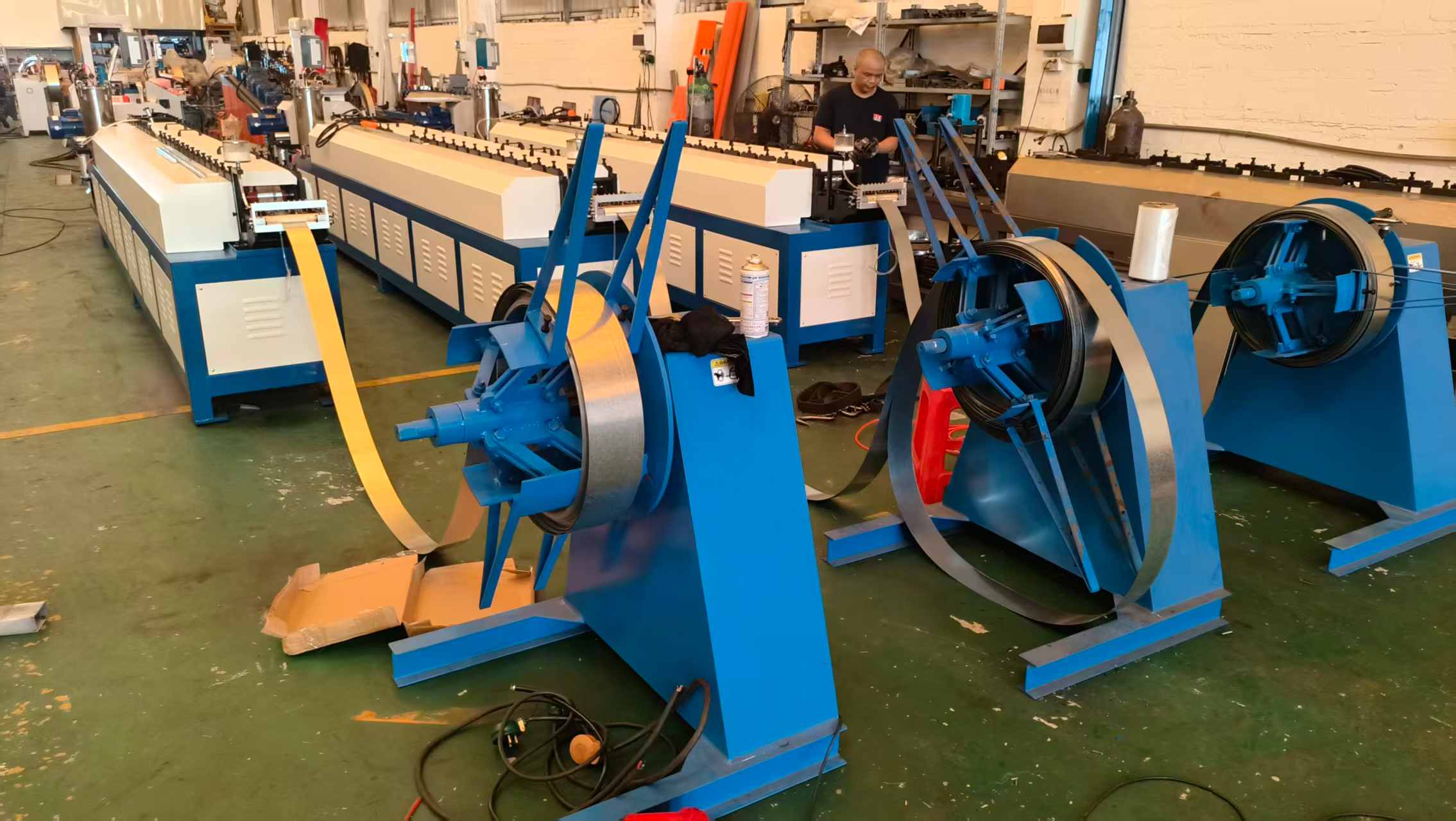
The line starts with uncoiling and leveling. Metal comes straight from large coils. This method cuts down on waste because you skip pre-cut sheet scrap. Precision CNC shearing gives you cut-to-length accuracy. You use only the exact metal each duct section needs.
The system does fixed-size shearing with a hydraulic unit. Beading and automatic groove cutting take place at the leveling and grooving roller station. That unit flattens the sheet and makes reinforcing beads and grooves. Hydraulic corner notching comes next. The line also does Pittsburgh lock forming and TDF flange forming. A TDF flange system makes the flanges your crew needs for assembly. The same station handles angle iron flange forming. These tdf flange forming units work inline without stopping the flow.
High automation and robotic feeding keep the pace steady. The line reaches speeds around 0-30 fpm. It handles 60″ x 18 gauge galvanized metal with a maximum duct length of 13′. For HVAC duct manufacturing, that capacity covers most standard rectangular work.
Fully automated computer control runs the whole sequence. A Panasonic PLC manages the logic. A Weilun touch screen gives your operator CNC-controlled operation for feeding and processing. A Nemicon rotary encoder provides accurate position feedback for precise cutting and forming. Yaskawa servo motors drive motion control across feeding, straightening, beading, notching, shearing, and braking. Schneider electrical components add strong performance.
The table below shows how each component helps with precision and efficiency.
|
Component |
Brand |
Contribution to Precision & Efficiency |
|---|---|---|
|
Servo motor |
Yaskawa |
Precise motion control in feeding, straightening, beading, notching, shearing, and braking |
|
PLC |
Panasonic |
Touch Screen CNC controlled automation of the full process |
|
Rotary Encoder |
Nemicon |
Accurate position feedback for precise cutting and forming |
|
Touch Screen |
Weilun |
CNC-controlled operation for automated feeding and processing |
After forming, the line folds the duct into L, U, or square (square) shapes. These pieces come out ready for assembly. You skip manual folding steps completely. The complete duct production line handles decoiling, feeding, hydraulic corner notching, and seam closing as one continuous operation.
LOCKFORMING offers models I through HVAC duct machinery line and customizable solutions. Whether you run a medium shop or a large air duct manufacturing plant, you can match a duct production line to your output goals. Each duct production line in the range shares the same focus on reliable components and inline automation.
You gain real, measurable benefits when you move from manual work to a fully automatic duct production line. The advantages of a fully automatic duct production line show up in your daily output, your quality numbers, and your bottom line. LOCKFORMING designed the Auto Line VI to deliver these gains for medium and large duct manufacturing facilities.
Speed is the first advantage you notice. The LOCKFORMING Auto Line VI completes one duct piece in about 20–23 seconds. That cycle time covers feeding, cutting, notching, forming, and folding in one pass.
The production efficiency is high (about 20-23 seconds per piece).
This pace changes your production planning. You quote more jobs and meet tighter deadlines without adding shifts.
Quality consistency follows speed. A fully automatic duct production line removes the human error that creeps into manual forming. The system controls every step with precision.
Waste reduction is the third gain. The line uses coil stock and cuts to exact length. You skip the scrap that comes from pre-cut sheets and manual layout mistakes. The table below shows the quality checkpoints embedded in the line.
|
Quality-Control Checkpoint |
What Is Verified |
Contribution to Dimensional Accuracy and Consistency |
|---|---|---|
|
Material accuracy |
Sheet thickness and coil quality before production |
Ensures uniform input material, preventing thickness-related dimensional deviations |
|
Dimensional consistency |
Cutting length, notch position, and folding accuracy |
Directly controls the key dimensions of each duct panel for repeatable results |
|
Surface quality |
Scratches, deformation, or coating damage |
Prevents physical defects that could affect fit, assembly, or airtightness |
|
Finished duct inspection |
Flange dimensions, seam quality, and overall appearance |
Confirms final product meets specifications before shipment |
These checkpoints run throughout the automatic duct production line. Routine inspections reduce material waste, minimize production errors, and ensure reliable product quality before shipment.
Labor savings form the second major advantage. A traditional manual duct shop needs 5–8 skilled workers. A fully automatic duct production line needs only 1–2 unskilled operators. That is a workforce reduction of 3 to 7 workers.
|
Production Method |
Workers Required |
Skill Level |
|---|---|---|
|
Traditional manual duct making |
5–8 |
Skilled |
|
Full-automatic duct production line |
1–2 |
Unskilled operators |
You redirect those saved wages to other parts of your business. The advantages of a fully automatic duct production line also include a fast payback. A realistic ROI assessment must also consider asset depreciation and financing terms. The machine’s value will depreciate over time via straight-line or accelerated depreciation methods. This impacts your accounting expenses and tax obligations. If you finance the machine through loans or leasing, monthly payments, interest rates, and financing fees must be incorporated into your ongoing cost structure. These affect your net cash flows and alter the timing of your investment payback. Calculating the payback period—the length of time required for cumulative gains to equal your initial investment—is critical. A shorter payback period generally indicates a more attractive investment, especially if cash flow constraints are a concern.
For hvac duct manufacturing, these advantages of a fully automatic duct production line translate into lower operational costs and higher duct processing efficiency. Your duct production line becomes a profit center, not a cost burden.
The biggest difference between automatic and semi-automatic setups is throughput and labor. A semi-automatic line needs people to do some steps by hand. That slows you down and requires more skilled workers. A fully automatic duct production line runs every step on its own. The speed stays steady, and you hire fewer operators.
LOCKFORMING offers systems at both levels. The table below shows how labor needs change with automation.
|
Setup |
Automation Level |
Labor Requirement |
|---|---|---|
|
Auto Duct Line 3 |
Semi-automatic |
Moderate |
|
Auto Duct Line 5 |
Highly automatic |
Low |
The Auto Duct Line 3 needs a moderate amount of labor because your team handles some tasks. The Auto Duct Line 5 needs little labor because the duct production line runs almost everything. This shows how automation level links directly to your workforce size. You lower labor costs when you pick the right duct production line.
Quality consistency is different too. Semi-automatic lines depend on operator skill. You get changes between shifts. An automatic system removes that risk with CNC control. Every duct matches the programmed settings. Your output stays the same across every duct length you make. You give your customers a better duct.
You pick a full automatic duct production line when your volume is big enough to support the cost. Medium to large facilities gain the most. These shops have enough work to keep the machine busy. You get your money back through labor savings and higher throughput. This duct production line handles high demand without extra labor.
High-volume duct production needs the speed of full automation. The Auto Line VI makes one piece every 20-23 seconds. That pace keeps output going without delays. Your team spends time on assembly instead of forming. High-volume duct fabrication becomes more profitable when you automate forming.
LOCKFORMING sells models I through VIII for different sizes. You start with a smaller line and upgrade later. These duct production lines cover different volume needs. Or you install a complete duct production line from day one. Different duct production lines fit different shop sizes. Each duct production line uses the same quality parts. This cuts training time and makes maintenance easier across your shop.
Duct manufacturing shops that serve many HVAC contractors need steady quality at speed. An automatic duct production line gives you that mix for any HVAC project. You quote more projects and finish them with fewer people.
Your duct production lines work as one long flow from coil to finished duct. Knowing this flow helps you get the most out of it. Good upkeep keeps your automated workflow running at top speed.
The fully automated workflow starts with loading galvanized steel coils onto material racks. This step removes coiling stress and makes the sheet flatter.
This sequence is a modern duct manufacturing process. LOCKFORMING builds their Auto Line VI to do these steps in one smooth run. You get steady results with little handling for any hvac project.
Steady efficiency depends on good care of your equipment. Routine maintenance boosts output and makes equipment last longer.
Check the electrical system often and fix problems fast. Look over the hydraulic system and fix issues right away to stop more damage. Grease all machines often to lower wear.
Annual maintenance should include:
Preventive maintenance costs much less than fixing surprise breakdowns. Think about a common fault: poor dimensional accuracy.
|
Fault Symptom |
Possible Causes |
Troubleshooting Methods |
|---|---|---|
|
Poor dimensional accuracy |
Worn forming rollers; uneven sheet thickness; feeding system slipping; incorrect control parameters |
Inspect or replace rollers; check material quality; adjust feeding pressure; recalibrate |
Wrong control parameters lower efficiency over time. The reliability of your PLC system, servo motors, and after-sales support directly affects production stability. Your duct production lines run longer between service intervals with a planned maintenance plan. This keeps your duct manufacturing process profitable.
Automated feeding, CNC control, and inline forming work as a team to bring clear efficiency gains. You get faster output, steady duct quality, and lower labor costs. These advantages help your shop stay competitive.
Think about your production volume and labor needs before you invest. A full automatic duct line works best for medium to large facilities. LOCKFORMING offers models I through VIII for different sizes.
Automation keeps shaping how hvac duct manufacturing competes. More demand for energy-efficient systems drives this change. Your duct production line becomes a key asset.
The Auto Line VI finishes one duct piece in about 20 to 23 seconds. This cycle does feeding, cutting, notching, forming, and folding in one run. You get steady output with no pauses between steps.
You need only 1–2 unskilled operators. A shop that works by hand needs 5–8 skilled workers. LOCKFORMING makes systems that cut your need for workers by 3 to 7 people.
LOCKFORMING offers models I through VIII and customizable solutions. Medium to large facilities get the most benefit from the Auto Line VI. Smaller shops can begin with a smaller model and move to a bigger one as they make more ducts.
Calibrate servo motors once a year. Inspect forming rollers for wear. Back up your PLC software and check electrical wiring. Taking care of the machine before it breaks costs much less than fixing it after, and it keeps your duct production steady.
Yes. Extra features include punching support air and common plate flange hole punching. These extras let you change what you make for different duct specs without needing to change your main production flow.
online service



 IPv6 network supported