
HVAC Duct Manufacturing: The Complete Guide to Efficient Ductwork Production
Introduction
In modern commercial, industrial, and residential HVAC systems, ductwork serves as the backbone of air distribution. High-quality duct manufacturing directly impacts system efficiency, indoor air quality, energy consumption, and long-term operating costs.
As HVAC projects become larger and more complex, contractors and duct fabrication shops are
increasingly adopting automated duct manufacturing solutions to improve productivity, reduce labor costs, and maintain consistent quality.
This guide explores the complete HVAC duct manufacturing process, key equipment involved, and how advanced production lines help manufacturers stay competitive in today's market.

What Is HVAC Duct Manufacturing?
HVAC duct manufacturing refers to the process of producing air ducts used in heating, ventilation, and air conditioning systems. These ducts transport conditioned air throughout buildings and industrial
facilities.
The most common duct types include:
• Rectangular ducts
• Spiral ducts
• Round ducts
• Oval ducts
• Insulated ducts
Depending on project requirements, ducts are fabricated from galvanized steel, stainless steel, aluminum, or other specialized materials.

The HVAC Duct Manufacturing Process
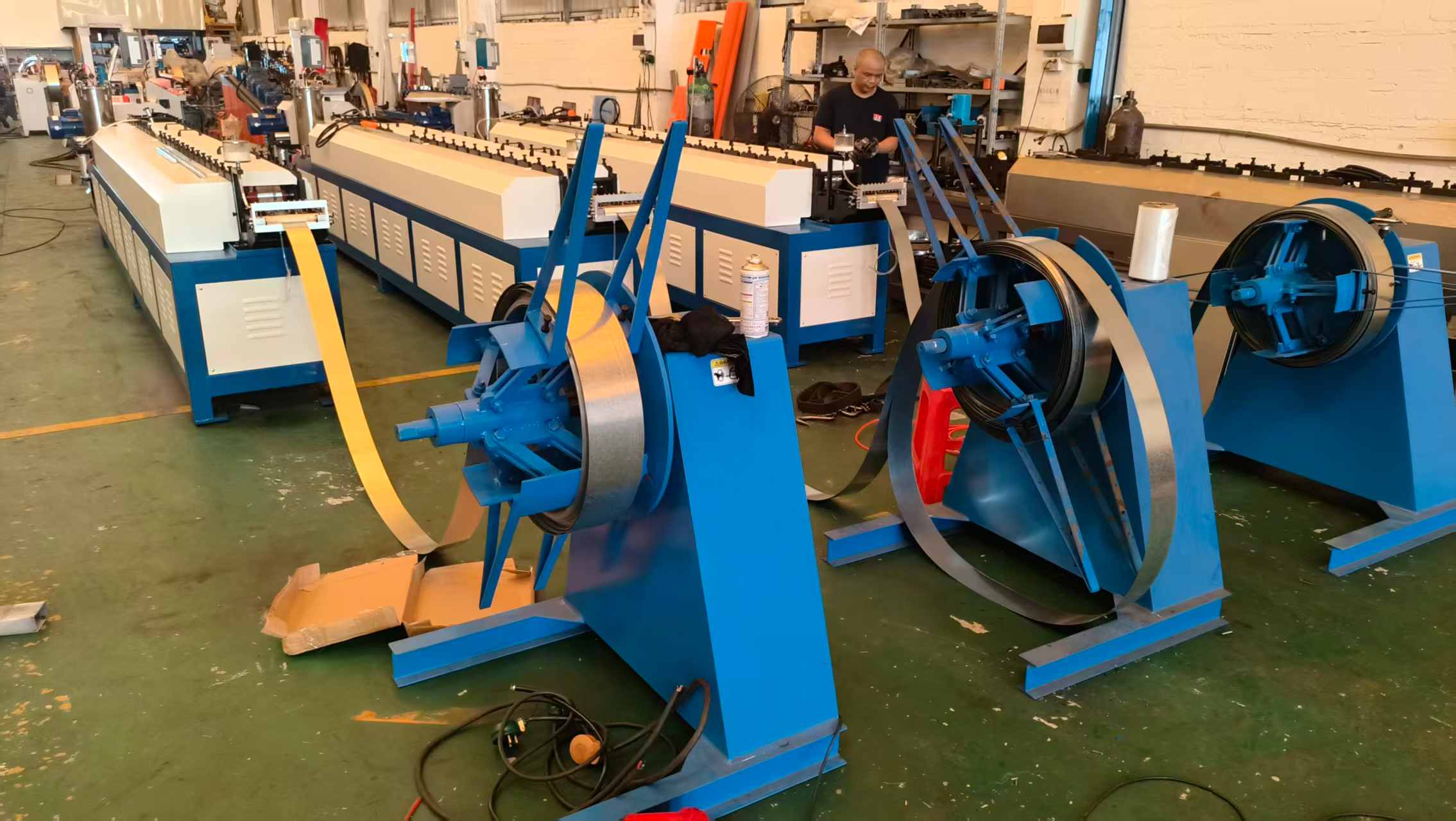
1. Sheet Metal Preparation
The manufacturing process begins with galvanized steel coils or sheet metal. The material is:
• Uncoiled
• Leveled
• Cut to size
• Notched and punched
Modern duct production lines can automatically perform these operations with high precision, minimizing material waste.
2. Plasma Cutting and Sheet Processing
Using CNC-controlled cutting systems, manufacturers can quickly produce complex duct components based on CAD drawings.
Benefits include:
• Improved accuracy
• Faster production
• Reduced human error
• Better material utilization
3. Pittsburgh Lock Forming
One of the most important steps in rectangular duct fabrication is creating strong seam connections.
Pittsburgh lock forming machines create precise locking profiles that allow duct sections to be securely joined during assembly.
Advantages include:
• Strong structural integrity
• Airtight connections
• Faster assembly time
• Consistent quality
4. TDF and TDC Flange Forming
Flanges provide the connection points between duct sections.
TDF flange systems have become the preferred choice for many HVAC manufacturers due to:
• Reduced material costs
• Faster installation
• Improved sealing performance
• Lower labor requirements
Automated flange forming machines significantly improve production efficiency while ensuring dimensional accuracy.
5. Folding and Assembly
After lock forming and flange production, duct sections are folded into their final shape.
Advanced folding machines allow manufacturers to produce:
• Square ducts
• Rectangular ducts
• Special transition pieces
• Custom fittings
The assembled sections are then inspected before packaging.

Why Automation Is Transforming HVAC Duct Manufacturing
Traditional manual fabrication methods often struggle to meet modern production demands.
Today's automated duct manufacturing lines offer significant advantages:
Higher Productivity
Automated systems can process large volumes of ductwork with minimal operator intervention.
Reduced Labor Costs
Manufacturers can address labor shortages while maintaining production capacity.
Improved Accuracy
Computer-controlled equipment minimizes dimensional errors and rework.
Consistent Product Quality
Every duct section is produced according to predefined specifications, ensuring uniform quality across projects.
Better Material Utilization
Automated nesting and cutting reduce scrap rates and maximize coil usage.

Essential Equipment for HVAC Duct Fabrication Shops
To build a complete duct manufacturing facility, the following equipment is commonly required:
Auto Duct Line
Used for automatic feeding, leveling, beading, notching, punching, and cutting.
Pittsburgh Lock Forming Machine
Produces locking seams for rectangular duct assembly.
TDF Flange Forming Machine
Creates integrated flange connections for duct sections.
Hydraulic Folding Machine
Folds sheet metal into finished duct shapes.
Spiral Duct Machine
Manufactures round and spiral ducts for commercial and industrial ventilation systems.
Corner Inserting and Assembly Equipment
Improves assembly speed and reduces manual handling.
|
Choosing the Right HVAC Duct Manufacturing Solution When investing in duct fabrication equipment, manufacturers should consider: • Production volume • Duct types required • Labor availability • Factory space • Future expansion plans A scalable production line allows businesses to increase capacity while maintaining efficiency and profitability. Partnering with an experienced equipment supplier can also help optimize workflow design and reduce implementation risks. |
|
The Future of HVAC Duct Manufacturing The HVAC industry continues to move toward smarter, faster, and more automated production methods. Emerging trends include: • Industry 4.0 integration • Smart factory management • CNC automation • Digital production monitoring • Energy-efficient manufacturing Manufacturers who adopt advanced duct fabrication technologies will be better positioned to meet growing market demand while maintaining competitive pricing. |
online service



 IPv6 network supported