



How Are HVAC Ducts Manufactured? Complete Guide to HVAC Duct Fabrication Process
HVAC ducts are manufactured through a precise sequence of automated and manual processes that transform raw metal coils into functional air distribution components. The standard fabrication workflow begins with material selection typically galvanized steel, aluminum, or stainless steel by decoiling, leveling, precision cutting via CNC plasma or laser systems, seam forming (such as Pittsburgh lock or snap lock), flange creation, and final assembly with gaskets and reinforcements. Modern HVAC duct manufacturing relies heavily on integrated production lines and specialized machinery to ensure dimensional accuracy, airtightness, and compliance with international standards like SMACNA and DW/144.
This guide addresses common search intents including how to fabricate HVAC ducts, HVAC duct manufacturing process step by step, and sheet metal duct production guide. Whether you are establishing a new duct factory or optimizing an existing workshop, understanding each stage of fabrication is critical for achieving efficiency, quality, and cost-effectiveness in commercial and industrial ventilation projects.
1. Raw Materials and Specification Standards
The foundation of high-quality HVAC ductwork lies in appropriate material selection. Different environments demand specific metals based on corrosion resistance, fire rating, thermal performance, and mechanical strength.
| Material Type | Typical Thickness Range | Primary Application | Key Properties |
|---|---|---|---|
| Galvanized Steel (G90) | 0.5 mm – 1.2 mm | Standard supply & return air ducts | Corrosion-resistant, cost-effective, weldable |
| Aluminum Alloy | 0.6 mm – 1.0 mm | Marine, chemical, coastal environments | Lightweight, non-magnetic, excellent corrosion resistance |
| Stainless Steel (304/316) | 0.7 mm – 1.5 mm | High-temp exhaust, food processing, labs | Superior heat & chemical resistance, hygienic surface |
| Foil-Faced Insulation Board | 20 mm – 30 mm core | Pre-insulated ducts for energy efficiency | Thermal/acoustic insulation integrated, lightweight |
Material thickness must align with duct dimensions per SMACNA guidelines to prevent vibration and leakage. For example, rectangular ducts exceeding 600 mm width typically require 0.8 mm G90 steel minimum. Reputable manufacturers like Guangzhou Lockforming Machinery Co., Ltd. design their equipment to handle multiple gauges seamlessly, ensuring flexibility across diverse project specifications.
2. Automated Rectangular Duct Production Line Workflow
Modern rectangular duct fabrication is dominated by fully automatic duct production lines, which integrate multiple stations into one continuous system. These lines significantly reduce labor dependency and improve consistency compared to traditional bench-top methods.
A typical CE-certified duct production line includes the following stages:
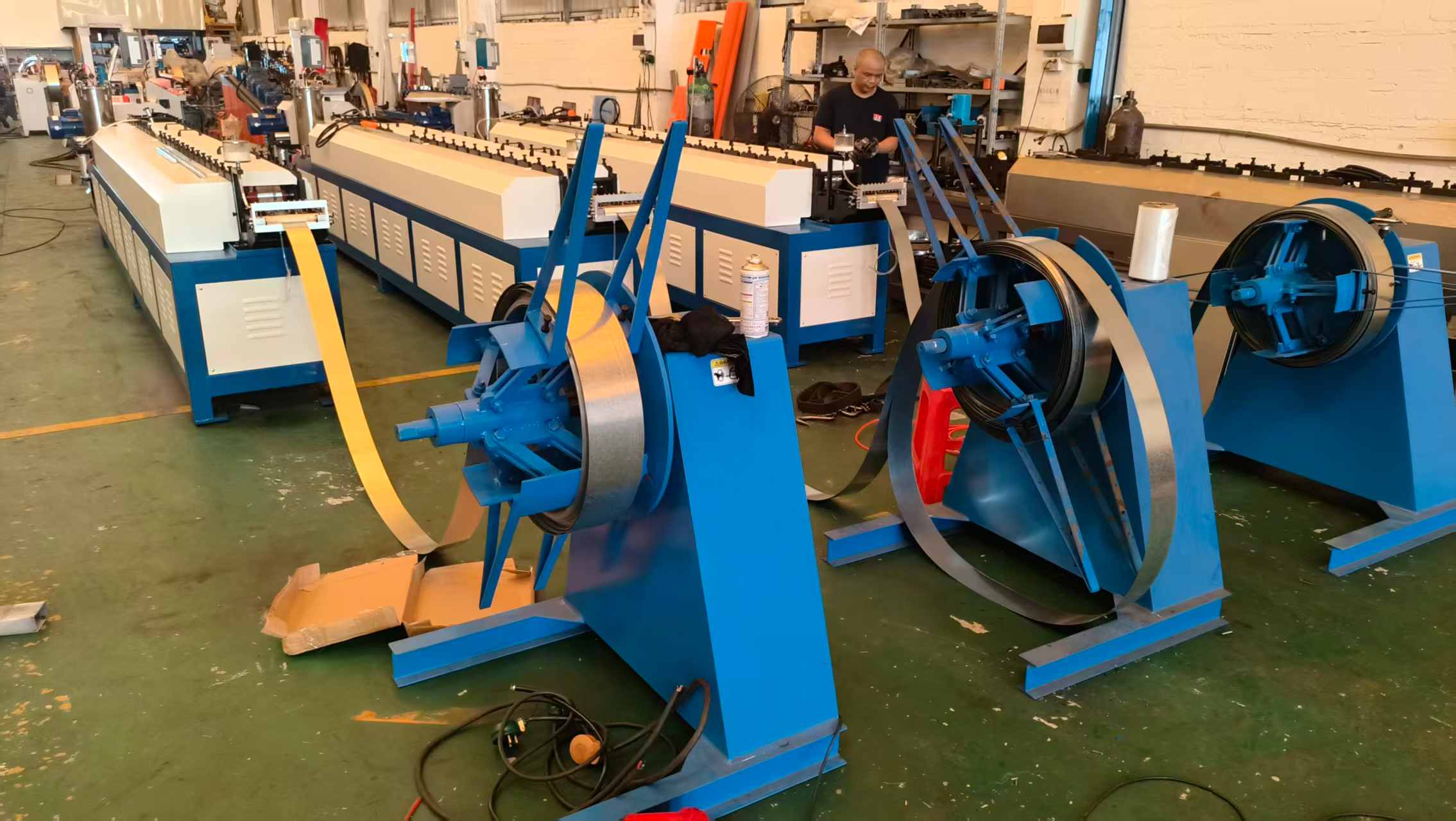
- Decoiling & Leveling: Metal coil is fed through a motorized decoiler and multi-roll leveler to eliminate curl and ensure flatness.
- Notching & Grooving: Precision punches create corner notches and seam grooves based on programmed duct dimensions.
- Cutting: Hydraulic shear or CNC plasma cutter trims the sheet to exact length with ±0.5 mm tolerance.
- Pittsburgh Lock Forming: Roll-forming station creates interlocking seams along longitudinal edges for airtight joints.
- Flange Formation: TDC/TDF flanges are rolled directly onto duct ends, eliminating separate angle iron framing.
- Folding & Assembly: Automated folder bends the sheet into rectangular shape; operators then secure corners with clips or spot welding.
Lockforming’s duct production lines are engineered for global markets, featuring modular designs that allow customization based on factory space and output requirements. With monthly production capacity exceeding 100 machine sets and CE certification, these systems meet stringent European safety and performance benchmarks while maintaining cost efficiency for emerging market buyers.
3. Spiral Duct Manufacturing Process
Spiral (round) ducts are preferred for main trunk lines due to lower airflow resistance, reduced noise, and faster installation. Their manufacture requires dedicated spiral duct machines that operate on a fundamentally different principle than rectangular lines.
The process begins with a narrow metal strip fed into a spiral former. As the strip advances, it is continuously roll-formed into a helical seam while simultaneously being bent into a circular cross-section. The overlapping edges are locked together under pressure, creating a rigid, self-supporting tube without longitudinal welds. Advanced models include inline insulation wrapping and automatic cutoff systems.
| Parameter | Spiral Duct | Rectangular Duct |
|---|---|---|
| Airflow Efficiency | Higher (smooth interior, no corners) | Lower (turbulence at corners) |
| Installation Speed | Faster (lighter, fewer supports needed) | Slower (heavier, more hangers) |
| Space Requirement | Requires vertical clearance | Fits tight ceiling plenums |
| Fabrication Equipment | Specialized spiral machine | Duct line + brake press |
Lockforming’s spiral duct machines are widely exported to regions with high-rise construction booms, where round duct dominance is growing. Backed by lifelong after-sales support and localized technical teams, these machines offer reliable uptime even in remote job sites a key differentiator against suppliers offering only transactional sales.
4. Specialized Components: Fire Dampers and Fittings
HVAC systems require numerous accessories beyond straight duct sections. Fire dampers, elbows, transitions, and access doors must be fabricated to match duct specifications while meeting fire safety codes.
Fire damper production involves precision stamping of blade assemblies, frame welding, and actuator mounting all requiring dedicated fire damper machines. Similarly, C-channel forming machines produce structural supports for large ducts, while VCD (Volume Control Damper) machines automate louver and linkage fabrication. Integrating these specialized units into your workflow ensures component compatibility and reduces outsourcing dependencies.
5. Quality Control and Testing Protocols
Rigorous QC is non-negotiable in HVAC fabrication. Industry best practices include:
- Dimensional Verification: Laser measurement of diameter, squareness, and flange alignment against CAD drawings.
- Airtightness Testing: Pressure decay tests per EN 15727 Class A/B/C standards using calibrated leak testers.
- Surface Inspection: Visual checks for scratches, zinc coating defects, or improper seam engagement.
- Traceability: Batch coding linking each duct to material certificates and operator logs.
Guangzhou Lockforming Machinery implements this same QC rigor within its own 6,100 m² facility, applying lessons learned from internal manufacturing to refine customer equipment. This hands-on experience translates into machines that inherently support compliance-driven production.
Frequently Asked Questions (FAQ)
What core equipment is needed to start an HVAC duct fabrication shop?
A basic setup requires a duct production line (for rectangular ducts), a spiral duct machine (if producing round ducts), a CNC plasma cutting table for fittings, and hand tools for assembly. Additional machines like fire damper formers and C-channel rollers enhance capability. Lockforming offers turnkey packages tailored to startup budgets and regional code requirements.
How does CE certification impact HVAC machinery exports?
CE marking confirms compliance with EU Machinery Directive 2006/42/EC, covering electrical safety, emergency stops, and risk assessment. It is mandatory for selling equipment in Europe and often required by multinational contractors globally. All Lockforming machinery carries valid CE certification, verified through third-party testing bodies.
What is the typical ROI timeline for automated duct fabrication equipment?
With proper utilization, most workshops achieve payback within 18–24 months through labor savings, reduced rework, and higher throughput. Lockforming’s mass-production model keeps equipment costs competitive without sacrificing durability, accelerating ROI for small-to-midsize fabricators.
Conclusion: Choosing the Right Manufacturing Partner
Understanding how HVAC ducts are manufactured empowers procurement teams to evaluate suppliers beyond price alone. True value emerges from equipment reliability, technical support continuity, and alignment with international standards. Guangzhou Lockforming Machinery Co., Ltd., founded in 2007 and operating since with CE-certified production, exemplifies this holistic approach. With 20 years of specialization, a 5-engineer R&D team, and lifetime after-sales follow-up, Lockforming doesn’t just sell machines—it builds sustainable duct factories worldwide. For HVAC contractors and fabricators seeking long-term operational excellence, partnering with an experienced manufacturer like Lockforming transforms fabrication from a cost center into a strategic advantage.
 IPv6 network supported